Most of California’s wine valleys run north to south, walling the coast away from the vines. The Santa Ynez Valley does the opposite, and that single accident of geology is the reason everything tastes the way it does here. The Bureau of Alcohol, Tobacco and Firearms approved the Santa Ynez Valley as a federal appellation on May 15, 1983, on a petition led by Firestone Vineyard, the region’s first modern commercial winery. It became the nation’s thirty-second AVA and Santa Barbara County’s second. In the four decades since, the valley has grown from a handful of ranchers and dreamers into a thirty-mile corridor holding four sub-appellations and more than eighty vineyards, the kind of place where you can taste cool-climate Chardonnay at breakfast and a sun-soaked Cabernet by dinner without leaving the county.
The Santa Ynez Valley is a 30-mile stretch of wine country in Santa Barbara County where Pinot Noir, Syrah, Grenache, and Rhone varieties thrive in cool Pacific-influenced air. The valley contains five distinct appellations, from the foggy Sta. Rita Hills in the west to the warmer Happy Canyon in the east, and is home to more than 100 wineries, many open for tasting without a reservation. The region gained international attention through the 2004 film Sideways and has since grown into one of California’s most visited wine destinations.
What Is Santa Ynez Valley Wine Country?
The story starts with the mountains, and the mountains here run the wrong way. The Santa Ynez and San Rafael ranges are part of California’s transverse ranges, the rare stretch of coastline where tectonic forces rotated the land over millions of years until the hills lay east to west instead of north to south. That orientation turns the valley into a funnel. Cold Pacific air and marine fog pour straight through the open western mouth near Lompoc and travel inland every afternoon, then burn off and warm as they go. The result is a temperature gradient you can almost set your watch by. The western edge of the valley stays cool and gray well into the morning, while the eastern end bakes in afternoon sun that pushes into the nineties.
That gradient is the whole game. Daytime heat ripens the fruit, then the fog and the night wind drop temperatures thirty to forty degrees after dark, and that swing is what locks in the bright acidity that keeps these wines alive instead of flabby. Soils shift across the valley too, from sand and shale near the coast to clay loam and, in pockets of Ballard Canyon, a vein of limestone subsoil that is common in the Rhone and rare in California. Stand in one vineyard at the cool western end and another twenty miles east, and you are in two different worlds wearing the same name.
Santa Ynez Valley Wine Appellations: Five Distinct Growing Areas
The Santa Ynez Valley is unusual in holding four federally recognized sub-appellations within its borders, lined up roughly west to east by how much fog reaches them. Each one was carved out as growers came to understand which ground did what, and together they read like a map of the valley’s climate from cool to warm.
Sta. Rita Hills
The coolest, foggiest ground at the western mouth, and California’s great answer to Burgundy. The transverse hills funnel ocean wind straight to the vines, ripening world-class Pinot Noir and Chardonnay with oceanic lift and serious acid.
Ballard Canyon
A small north-south canyon in the valley’s center, the smallest sub-AVA and the valley’s Syrah heartland. More than half its vines are Syrah, with Grenache, Viognier and Roussanne behind it, grown over limestone-laced soils that give the reds weight and a savory, peppery edge.
Los Olivos District
A broad, even alluvial terrace through the middle of the valley, moderate in climate and the most stylistically flexible ground here. It ripens Bordeaux grapes like Cabernet Sauvignon and Sauvignon Blanc alongside Rhone varieties, and its tasting rooms anchor the town of the same name.
Happy Canyon of Santa Barbara
The hottest, easternmost corner, tucked against the hills past Lake Cachuma. Magnesium-rich serpentine soils and daytime highs in the nineties make it the valley’s Bordeaux country, home to structured Cabernet Sauvignon, Merlot, Petit Verdot and racy Sauvignon Blanc.
Santa Ynez Valley floor
The broader appellation that holds all the others, plus the gentle valley bottom and the towns of Santa Ynez, Los Olivos, Solvang and Buellton. A catch-all that still grows a remarkable range, from Riesling and Chardonnay to Syrah, on the warmer benchland between the named sub-zones.
| Appellation | Known For | Climate |
|---|---|---|
| Sta. Rita Hills | Pinot Noir, Chardonnay | Coldest, heavy morning fog from the Pacific |
| Santa Ynez Valley | Rhone varieties, Bordeaux blends | Moderate, warming toward the east |
| Los Olivos District | Syrah, Grenache, Sauvignon Blanc | Warm days, cool evenings |
| Ballard Canyon | Syrah (benchmark California Syrah) | Warm, protected by hills |
| Happy Canyon | Cabernet Sauvignon, Bordeaux varieties | Warmest in the valley, long growing season |
What Wines Santa Ynez Valley Is Known For
Because the valley spans cool coast to hot inland in thirty miles, it grows a wider range than almost any single AVA in the state, and it grows each grape where the climate actually suits it. At the cool western end, Pinot Noir and Chardonnay are the signatures, the fog-fed grapes that built the region’s reputation and made the Sta. Rita Hills a name that serious Pinot drinkers know by heart. These are not soft, sunny California versions. The cold air and big diurnal swing keep them taut and mineral, closer in spirit to Burgundy than to Napa.
Move toward the warm center and Rhone varieties take over. Syrah is the valley’s red workhorse, especially in Ballard Canyon, where it comes blackberry-dark and pepper-spiced with the acid still intact, joined by Grenache, Viognier and Roussanne. Then in the hot eastern reach of Happy Canyon, Bordeaux grapes finally find enough heat to ripen fully, giving structured Cabernet Sauvignon and Merlot. The valley’s most underrated wine, though, may be Sauvignon Blanc, which Fred Brander has championed here since his first acclaimed release in 1977 and which thrives in both the cooler benchlands and the warm Happy Canyon hills.
| Zone | Climate | Signature grapes |
|---|---|---|
| Sta. Rita Hills (west) | Coolest, foggiest | Pinot Noir, Chardonnay |
| Ballard Canyon (center) | Moderate, breezy | Syrah, Grenache, Viognier |
| Los Olivos District (center) | Moderate, mixed | Bordeaux and Rhone varieties |
| Happy Canyon (east) | Warmest, sunbaked | Cabernet Sauvignon, Sauvignon Blanc |
Best Wineries in Santa Ynez Valley to Visit
The valley’s character lives in its families and pioneers, many of whom planted the first serious vines here in the 1970s and 1980s and are still pouring today. These are some of the names that defined Santa Ynez wine, several with full pages on Popular Wines.
Au Bon Climat
Jim Clendenen’s legendary house, born in 1982, that made Burgundy-style Pinot Noir and Chardonnay the way Santa Barbara would be measured for a generation. A foundational name in California cool-climate wine.
Brander Vineyard
Fred Brander’s estate near Los Olivos and the valley’s Sauvignon Blanc standard-bearer since his acclaimed 1977 release. The place to understand why this grape belongs here.
Gainey Vineyard
Four generations of Santa Ynez farmers behind a polished estate just east of Santa Ynez town, pouring Chardonnay, Pinot Noir and Syrah from both valley and Sta. Rita Hills fruit.
Firestone Vineyard
The region’s first modern commercial winery, founded by Leonard and Brooks Firestone and the petitioner behind the 1983 AVA. A grand estate on Foxen Canyon Road where the valley’s story really begins.
Rusack Vineyards
Geoff and Alison Rusack’s hillside estate above Ballard, set among oaks with one of the prettiest patios in the valley, known for Syrah and a beloved Ballard Canyon home.
Foxen
Dick Dore and Bill Wathen’s cult label on the historic Foxen Canyon ranch, whose original tasting room, “The Shack,” sits in an 1860s blacksmith shop. A true Foxen Canyon Wine Trail icon.
Sanford Winery
One of the founding names of Sta. Rita Hills Pinot Noir, farming the historic Sanford and Benedict vineyard where some of the county’s first cool-climate Pinot was planted.
Zaca Mesa
An early Rhone pioneer on Foxen Canyon Road, the training ground for a generation of Santa Barbara winemakers and a long-standing champion of estate Syrah.
How to Visit Santa Ynez Valley Wine Country
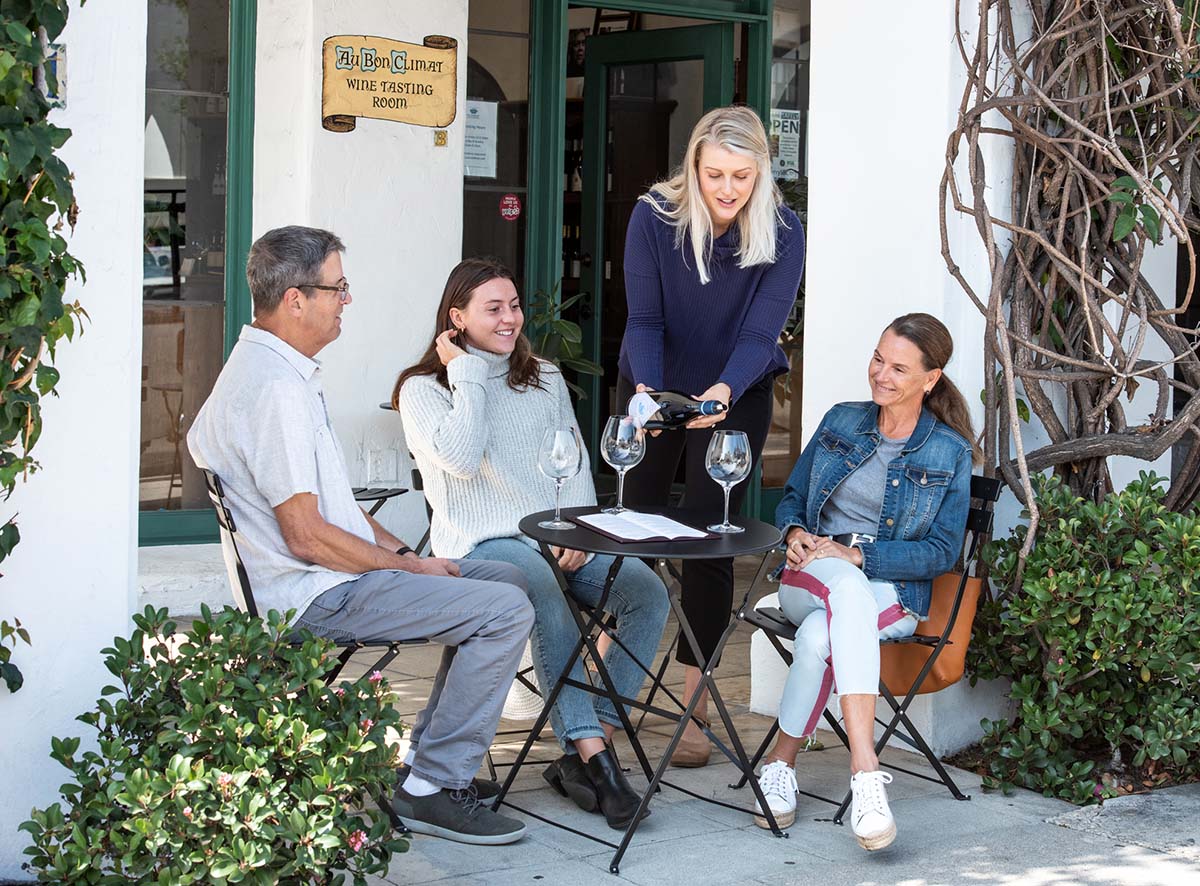
What makes this valley so easy to love is that you can taste it on foot or by the scenic mile. Start in Los Olivos, a one-stoplight town with close to thirty tasting rooms packed into a few walkable blocks. You can park once and spend the whole day going door to door, pouring from a dozen producers without ever starting the car, then break for lunch at one of the bistros along Grand Avenue. It is the most concentrated tasting walk in California wine country.
For the slower, prettier version, take the Foxen Canyon Wine Trail, the winding back road that links Firestone, Foxen, Zaca Mesa and others through oak groves and open ranchland north of the towns. It is a drive worth doing for the road alone. Down the valley sits Solvang, the famously Danish town with windmills, bakeries and aebleskiver on every corner, plus more than a dozen tasting rooms within walking distance of its downtown. Buellton, the gateway off Highway 101, sits in the center of everything and is the easy hub for a weekend. As for when to go, late spring through early fall brings the warmest, clearest weather and the liveliest tasting rooms, while harvest in September and October puts the whole valley in motion. Spring after the rains is the green secret, when the hills go emerald and the crowds have not yet arrived.
Where to Eat in Santa Ynez Valley Wine Country
The valley’s range is a gift at the table, because it gives you a wine for nearly any plate. The local food culture leans on Santa Maria-style oak-grilled tri-tip, ranch beef, and the lamb and citrus that grow in the surrounding hills, and the valley’s own grapes were built to meet exactly that. A Ballard Canyon Syrah, with its dark fruit, black-pepper edge and grippy tannin, is made for that charred, fatty tri-tip, the tannin binding to the protein and softening as the fat coats your tongue. A cool Sta. Rita Hills Pinot Noir, earthy and bright, finds its match in seared duck or mushroom risotto on shared savory notes. And the valley’s herbaceous Sauvignon Blanc and goat cheese is one of those pairings that clicks because both carry the same green, grassy compounds and read as a single flavor. Want a match for whatever you are cooking tonight, use our wine pairing generator to find the bottle that fits.
The Santa Ynez Valley is the warm, varied core of Santa Barbara County wine, itself part of the larger California wine story. Go deeper into its coolest corner at the Sta. Rita Hills, or follow the grapes themselves through our guides to Pinot Noir, Chardonnay and Sauvignon Blanc. However you wander in, the fog, the oaks and the families pouring their life’s work are waiting.
From foggy coastal Pinot to sun-baked inland Cabernet, find the bottle that fits your table tonight, then come taste it where it grows.
Santa Ynez Valley Wineries: Your Questions Answered
Where is the Santa Ynez Valley?
The Santa Ynez Valley sits in Santa Barbara County on California’s Central Coast, about a forty-five minute drive north of the city of Santa Barbara over San Marcos Pass. It runs roughly thirty miles east to west and takes in the towns of Santa Ynez, Los Olivos, Solvang and Buellton.
When did the Santa Ynez Valley become an AVA?
It was approved as a federal American Viticultural Area on May 15, 1983, after a petition led by Firestone Vineyard. It was the nation’s thirty-second AVA and the second in Santa Barbara County.
What are the sub-AVAs of the Santa Ynez Valley?
The valley contains four nested sub-appellations: Sta. Rita Hills at the cool western end, Ballard Canyon and the Los Olivos District through the center, and Happy Canyon of Santa Barbara in the warm east. They line up from coolest to warmest as you move inland away from the coast.
What grapes is the Santa Ynez Valley known for?
Pinot Noir and Chardonnay dominate the cool western Sta. Rita Hills, Syrah and other Rhone grapes thrive in the central Ballard Canyon, and Bordeaux grapes like Cabernet Sauvignon ripen in the hot eastern Happy Canyon. Sauvignon Blanc is a valley-wide signature white.
Why is the Santa Ynez Valley climate so unusual?
Its mountains run east to west, part of California’s transverse ranges, which opens the valley to the Pacific. Cool ocean fog and wind funnel inland every afternoon, keeping the western end cool and gray while the eastern end bakes, and the thirty to forty degree day-to-night temperature swing preserves the acidity that keeps the wines fresh.
What are the best towns for wine tasting in the Santa Ynez Valley?
Los Olivos is the standout, with close to thirty tasting rooms in a few walkable downtown blocks. Solvang, the Danish-themed town, has more than a dozen tasting rooms within walking distance, and Buellton works as a central hub. The Foxen Canyon Wine Trail offers the scenic drive-out version.
When is the best time to visit the Santa Ynez Valley?
Late spring through early fall brings the warmest, clearest weather and the most active tasting rooms, while September and October harvest puts the whole valley in motion. Spring just after the winter rains is the quiet, green secret, with emerald hills and smaller crowds.
What food pairs with Santa Ynez Valley wine?
The local table leans on Santa Maria-style oak-grilled tri-tip and ranch beef, which a peppery Ballard Canyon Syrah meets perfectly as its tannin binds to the fat. Cool Sta. Rita Hills Pinot Noir loves seared duck or mushroom dishes, and the valley’s herbaceous Sauvignon Blanc is a classic with goat cheese, since both share the same green, grassy aromas.