
Drive west out of Buellton on a summer morning and you can watch the temperature fall. The sun is high, the sky is clear, and yet a cold breath comes off the ocean and pours up the valley toward you, carrying fog and the smell of salt. This is the trick the Sta. Rita Hills plays every single day, and it is the whole reason this place exists. Richard Sanford, the man who first understood it, used to drive Highway 246 with a thermometer taped to the outside of his car. He found that the air cooled by roughly one degree for every mile he drove toward the sea. He was looking for somewhere cold enough, in sunny Southern California, to grow Pinot Noir the way Burgundy does. He found it here.
The place
Almost every coastal valley in California runs north to south, with mountains shielding the vines from the ocean. The Santa Ynez Valley does the opposite. The mountain ranges of Santa Barbara County are transverse ranges, running east to west rather than up and down the coast, and the western end of the valley opens like a funnel straight at the Pacific. Cold marine air and fog do not have to climb over anything. They simply roll in off the water, up the river plain between the Purisima Hills to the north and the Santa Rosa Hills to the south, and settle over the vineyards through the night and into the late morning. By early afternoon the fog burns back toward the coast, the sun does its work, and by dusk the cold returns. That daily swing, warm days and genuinely cold nights and mornings, is what keeps the grapes singing with acidity even as they ripen.
It is also one of the coldest and windiest growing regions in California. The wind here is relentless, and it matters. It thickens the grape skins, shrinks the berries, and stresses the vines into making small crops of intensely flavored fruit. The growing season is long and slow, which lets flavor develop while sugar stays in check, the exact recipe for wines that are vivid rather than heavy.
Then there is the ground itself. Tens of millions of years ago this was ocean floor, and the collision and rotation of the Pacific and North American plates lifted that seabed into hills and tilted it on its side. The soils are a patchwork of marine sediment, sandy and clay loams, and most famously diatomaceous earth, a chalky white deposit formed from the fossilized shells of microscopic algae and sea creatures. These are poor, well-draining, mineral-rich soils, the kind that frustrate most crops and delight a wine grape. Vines forced to dig and struggle here give back finesse, tension, and a savory, almost saline streak that growers and drinkers swear they can taste.
What they grow
This is Pinot Noir and Chardonnay country, and it earns that reputation without trying to be anything else. Pinot Noir is the heart of the place, accounting for the large majority of plantings, and Chardonnay is the clear second grape. These are the two varieties that built Burgundy on cold-climate, limestone-rich ground, and the Sta. Rita Hills offers a California answer that is unmistakably its own: bright red and dark cherry fruit, real structure, an earthy and spicy edge, and a cool-climate lift that keeps the wines fresh on the table. The Chardonnay here has turned the corner over the last decade toward something leaner and more energetic, full of citrus, white peach, and oyster-shell minerality rather than butter and oak. To understand how this fits into the bigger picture, it helps to read these wines alongside the rest of the state on our California Pinot Noir and California Chardonnay guides.
Pinot and Chardonnay are not quite the whole story. The same cold corridor suits cool-climate Syrah, which can be peppery and floral here rather than jammy, and a small but devoted band of growers has planted Gruner Veltliner, the Austrian white, which loves the wind and the chalk. You will also find dashes of Grenache, Sauvignon Blanc, and Pinot Gris, but make no mistake, when people talk about the Sta. Rita Hills, they are talking about Pinot Noir first and Chardonnay close behind.
Vineyards and wineries to know
This is a small appellation with an outsized roster. A handful of vineyards became famous enough that their names appear on bottles from dozens of different producers, and a tight circle of winemakers turned cold, windy hills into one of the most respected addresses in American wine.
Sanford and Benedict
Planted in 1971 by Richard Sanford and Michael Benedict, the first vineyard in what would become the Sta. Rita Hills. Its oldest blocks are still considered some of the greatest Pinot Noir ground in America, and its fruit feeds bottlings from many of the region’s best.
Sanford Winery
The label Richard Sanford built around that founding ground. The estate sits at the historic vineyard on Santa Rosa Road and remains the spiritual home of the appellation, the place where the whole story started.
Sea Smoke
Named for the fog that boils up the valley, Sea Smoke became one of the most sought-after Pinot Noir estates in California, its steep, cool hillside blocks producing dense, age-worthy wines that helped define the region’s reputation for power with finesse.
Mount Carmel
A revered hillside vineyard whose old vines yield small, concentrated crops. Long prized by top producers, Mount Carmel fruit shows the spicy, structured, savory side of Sta. Rita Hills Pinot at its most serious.
Melville
One of the appellation’s signature estates, Melville farms its own land with a strong focus on sustainability and a polished tasting room. Read our Melville guide.
Babcock
A pioneering Sta. Rita Hills estate with an eclectic, laid-back, rock-and-roll tasting room and bold, characterful wines. A favorite for visitors who want personality with their Pinot.
Brewer-Clifton
An acclaimed, single-minded house just outside the Lompoc Wine Ghetto, known for one-hundred-percent estate Pinot Noir and Chardonnay that show the cold, mineral edge of the place with no apology.
Domaine de la Cote
One of the most talked-about Pinot Noir projects in California, farming windswept hillside blocks at the cold western edge and making tense, ethereal, deeply structured wines that rank among the finest the state produces.
Au Bon Climat
Jim Clendenen’s legendary house draws fruit from the oldest section of Sanford and Benedict for some of its Pinot Noir, a link between Santa Maria Valley and these hills. Read our Au Bon Climat guide.
Gainey
The Gainey family farms its Evans Ranch vineyard within the Sta. Rita Hills, a cool western site feeding the estate’s Pinot Noir and Chardonnay. Read our Gainey guide.
How Sta. Rita Hills fits in the Santa Ynez Valley
The Sta. Rita Hills is the cold, coastal western corner of the larger Santa Ynez Valley, and it was the valley’s first sub-appellation when it was approved in 2001. That relationship explains a lot about Santa Barbara wine in a single drive. Start at the ocean end, here in the fog and wind, where Pinot Noir and Chardonnay thrive on the cold. Drive east toward Los Olivos and Solvang and the fog thins, the days warm, and the grapes change with the climate, giving way to Rhone varieties like Syrah and Grenache and to warm-loving reds. One valley, two very different worlds, all because of how far the ocean air can reach. The Sta. Rita Hills is the cool extreme, and it is why Santa Barbara County can claim both serious Pinot and serious Syrah within a half-hour of each other.
Visiting and the Lompoc Wine Ghetto
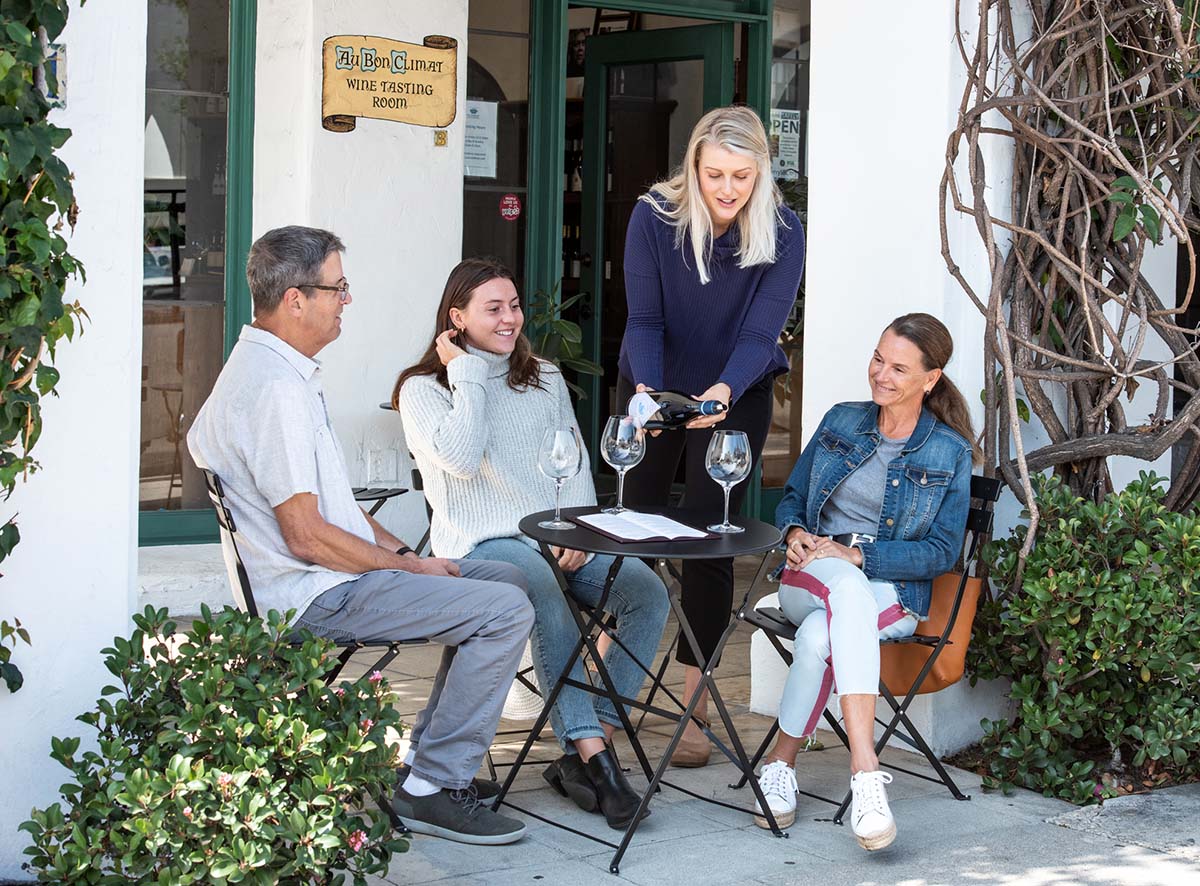
For a region that makes some of the country’s most coveted wine, the Sta. Rita Hills is refreshingly unglamorous, and that is the charm. The estate tasting rooms are scattered along Santa Rosa Road and Highway 246 between Buellton and Lompoc, set among working vineyards rather than manicured chateaux. But the heart of the visiting scene is an unlikely one: the Lompoc Wine Ghetto, a cluster of small wineries and tasting rooms tucked into an industrial park on the edge of town off Highway 1. It is the largest concentration of world-class, small-production tasting rooms in Santa Barbara County, and it is exactly what it sounds like, roll-up doors, concrete floors, barrels stacked in the back, and the actual winemaker often pouring your glass.
Most tasting rooms here cluster their hours toward Friday through Sunday, with a handful open Thursday or Monday, so it pays to check before you drive out. The reward is real intimacy. You can taste through a tiny producer’s entire range, talk to the person who made it, and buy bottles you will never find on a shelf. The town of Lompoc itself is plain and friendly, more flowers and farm fields than wine country glitz, which keeps the whole experience honest. Pack a jacket even in July, because the wind that makes the wine will find you too.
Food and the wines
The cold-climate structure of Sta. Rita Hills wine makes it some of the most food-friendly wine in California, and the logic is straightforward once you taste it. The Pinot Noir here carries real acidity and a savory, earthy edge, which is why it loves anything with a little fat and a little earth. Pour it with seared duck breast and a cherry pan sauce, the wine’s red fruit echoing the cherries while its acid cuts the richness of the skin. It is just as happy with roast chicken and mushrooms, the wine and the mushrooms meeting on the same savory, forest-floor notes, a classic bridge pairing where shared aromas make the match feel inevitable. Grilled salmon is the move when you want a red with fish, since Pinot’s gentle tannin will not turn metallic against the oily flesh the way a big Cabernet would.
The Chardonnay, leaner and more mineral than the old California style, is a natural with the cold Pacific that grew it. Think Dungeness crab, grilled halibut, oysters on ice, or a roast chicken with lemon and herbs. The wine’s citrus and oyster-shell freshness slices through butter and richness and resets your palate for the next bite. If you want a specific match for the bottle in front of you, our wine pairing generator will take it from here.
The Sta. Rita Hills rewards anyone willing to drive a little further west and feel the cold. To put it in context, explore the wider Santa Ynez Valley and the broader Santa Barbara wine scene, read up on the grapes that define the place in our California Pinot Noir and California Chardonnay guides, or visit producers like Au Bon Climat, Gainey, and Melville who draw on these hills.
Sta. Rita Hills questions, answered
Why is it spelled Sta. Rita Hills and not Santa Rita Hills?
The appellation was approved in 2001 as the Santa Rita Hills AVA, but Vina Santa Rita, a large Chilean wine producer, objected that the name infringed on its trademark and confused consumers. After years of negotiation, a compromise was approved by U.S. regulators in late 2005, and the region officially became the Sta. Rita Hills, using the abbreviation Sta. for Santa, effective in January 2006.
Where exactly is the Sta. Rita Hills?
It sits in the far western Santa Ynez Valley in Santa Barbara County, roughly between the towns of Buellton and Lompoc, in the river plain between the Purisima Hills to the north and the Santa Rosa Hills to the south. It is the cool, coastal corner of the valley, closest to the Pacific.
What wine is the Sta. Rita Hills known for?
Pinot Noir and Chardonnay, full stop. Pinot Noir makes up the large majority of plantings and Chardonnay is the clear second grape. The cold, foggy, windy climate is ideally suited to both, and the region is considered one of the finest cool-climate addresses in California, often compared to Burgundy.
Why is the climate so cool and foggy?
Unlike most California valleys, the Santa Ynez Valley runs east to west thanks to the transverse mountain ranges. Its western end opens directly to the Pacific, so cold marine air and fog pour straight up the valley over the vineyards each night and morning. That daily swing between warm days and cold nights keeps the grapes acidic and fresh while they slowly ripen.
What are the soils like?
The land was once ocean floor, lifted and tilted by tectonic plates. The soils are a mix of marine sediment, sandy and clay loams, and famously diatomaceous earth, a chalky white deposit formed from fossilized algae and sea life. These poor, well-draining, mineral-rich soils stress the vines into making small crops of intense, structured fruit.
Who founded the Sta. Rita Hills?
Richard Sanford and Michael Benedict planted the first vineyard, Sanford and Benedict, in 1971, after Sanford used his geography training and a car-mounted thermometer to find ground cold enough to grow Burgundian grapes. Sanford later drove the petition that created the AVA, which is why he is considered the father of the appellation.
What is the Lompoc Wine Ghetto?
It is a cluster of small wineries and tasting rooms in an industrial park on the edge of Lompoc, off Highway 1. It is the largest concentration of world-class, small-production tasting rooms in Santa Barbara County, an unglamorous spot where you can taste serious wine straight from the people who make it. Most rooms are open Friday through Sunday.
What food pairs with Sta. Rita Hills Pinot Noir?
Reach for seared duck breast with a cherry sauce, where the wine’s red fruit echoes the cherries and its acidity cuts the rich skin. Roast chicken with mushrooms is another natural, since the wine and the mushrooms share savory, earthy aromas. Grilled salmon works too, because Pinot’s soft tannin stays friendly against oily fish rather than turning metallic.