Most appellations earn their lines on a map by being dramatic, a steep hillside, a cold pocket, a strip of unusual stone. The Los Olivos District earned its lines by being calm. It is the one broad, level alluvial terrace the Santa Ynez River built across the middle of the valley, and that flat, uniform ground is exactly the point. The Alcohol and Tobacco Tax and Trade Bureau established the Los Olivos District as a federal American Viticultural Area on January 21, 2016, with the designation taking effect on February 22 of that year, the 232nd AVA in the country and one of the youngest nested inside the older Santa Ynez Valley. It runs roughly 22,820 acres through the center of the valley, with around a dozen bonded wineries and close to fifty vineyards working some 1,120 planted acres of it.
The place
Stand anywhere in the district and the first thing you notice is how little the land moves. The Los Olivos District sits on the only broad alluvial terrace plain along the Santa Ynez River, a nearly flat sheet of ground that slopes gently southward toward the water, dropping from about 1,000 feet in the northern foothills of the San Rafael Mountains to roughly 400 feet at the river. There are no significant hills inside the appellation to throw shade, block the rain, or stop the fog, so every vineyard drinks in much the same sun, the same rain, and the same thin morning marine layer. That sameness is the district’s signature, and it is why growers here can plant rows in any direction and farm with real consistency from block to block.
The climate is the inland, moderate middle of the valley. Sitting back from the cool coast, the district gets only a thin layer of marine fog that rolls in overnight and burns off fast in the morning, which means warm, sunny days and genuinely cold nights. That wide daily swing does the real work: the daytime heat builds ripeness and sugar, the cold dark hours lock in acidity, and the grapes come in ripe without going soft. Climate scientists rank it as a cool Winkler Region III, warm enough to finish Bordeaux grapes that struggle nearer the ocean, yet cool enough at night to keep everything fresh. The soils underneath are the other half of the story. More than ninety percent come from a single alluvial association, well-drained gravelly fine sandy loams and clay loams of low to moderate fertility, the kind of lean, free-draining river ground that makes vines work for their fruit rather than run to leaf.
What they grow
This is the district’s quiet superpower. Because the terrace is warm enough to fully ripen late grapes but cool enough at night to hold their acid, it grows across families that rarely share a single appellation. Bordeaux varieties feel at home here, Cabernet Sauvignon, Cabernet Franc, Merlot and Petit Verdot among the reds, with Sauvignon Blanc and Semillon on the white side. Rhone grapes are just as comfortable, led by Syrah and Grenache with Viognier and Roussanne behind them, the warm-day, cold-night profile suiting them as well as it does in the southern Rhone itself. Add in pockets of Italian and Iberian varieties and a steady run of Chardonnay, and you have one of the most varied planting maps in the state.
The reason it all works is that even, well-drained terrace. There is no single grape that defines the Los Olivos District the way Pinot Noir defines the foggy hills to the west or Cabernet defines the hot canyon to the east. Instead the district is defined by range, the ability to do a serious Bordeaux red, a peppery Rhone Syrah and a taut white from neighboring rows. For the grower it means options. For the drinker it means a single short stretch of valley that can fill a whole case with different wines.
| Family | Grapes that thrive | Why here |
|---|---|---|
| Bordeaux reds | Cabernet Sauvignon, Cabernet Franc, Merlot | Warm days finish ripening that fails nearer the coast |
| Rhone | Syrah, Grenache, Viognier, Roussanne | Hot day, cold night profile mirrors the southern Rhone |
| Whites | Sauvignon Blanc, Semillon, Chardonnay | Cold nights and lean soils keep acidity bright |
Wineries to know
The district’s character lives in its growers, and one of them quite literally drew the map. Fred Brander, whose family planted near Los Olivos in the 1970s, spent years studying this ground and authored the petition that became the AVA. These are names that define the district, several with full pages on Popular Wines.
Brander Vineyard
Fred Brander’s estate near Los Olivos and the valley’s Sauvignon Blanc standard-bearer. Brander did the soil and climate research and wrote the petition that established the Los Olivos District as its own appellation in 2016.
Gainey Vineyard
Four generations of Santa Ynez farmers behind a polished estate just east of town, pouring Chardonnay, Pinot Noir, Sauvignon Blanc and Syrah from both valley and cooler western fruit. A keystone visit on the district floor.
Andrew Murray Vineyards
Two decades of acclaimed Rhone wine from one of the region’s true Syrah believers, anchored by the celebrated Roasted Slope Syrah co-fermented with a touch of Viognier. A textbook expression of what the warm terrace does for Rhone reds.
Carhartt Family Wines
Mike and Brooke Carhartt planted their Rancho Santa Ynez vineyard in 1996 and released their first vintage in 1998, opening one of the smallest, friendliest tasting rooms in Los Olivos in 2005. Small-lot Syrah, Merlot and more from estate fruit.
Epiphany Cellars
The Rhone-focused label from the Parker family, built around Syrah, Grenache and Viognier grown on the warm middle of the valley. A pure look at the district’s southern-Rhone side.
Fess Parker Winery
The estate begun by the actor turned vintner, now run by Eli and Ashley Parker, pouring Rhone and Burgundy varieties from valley vineyards. A landmark of the Foxen Canyon stretch above the district.
Firestone Vineyard
The valley’s first modern commercial winery and the petitioner behind the original 1983 Santa Ynez Valley AVA, set on a grand bluff on Foxen Canyon Road just north of the district. Where the valley’s wine story really begins.
Rusack Vineyards
Geoff and Alison Rusack’s estate above neighboring Ballard, with one of the prettiest oak-shaded patios in the valley, an easy add-on to a day spent on the district floor.
Visiting the Los Olivos District
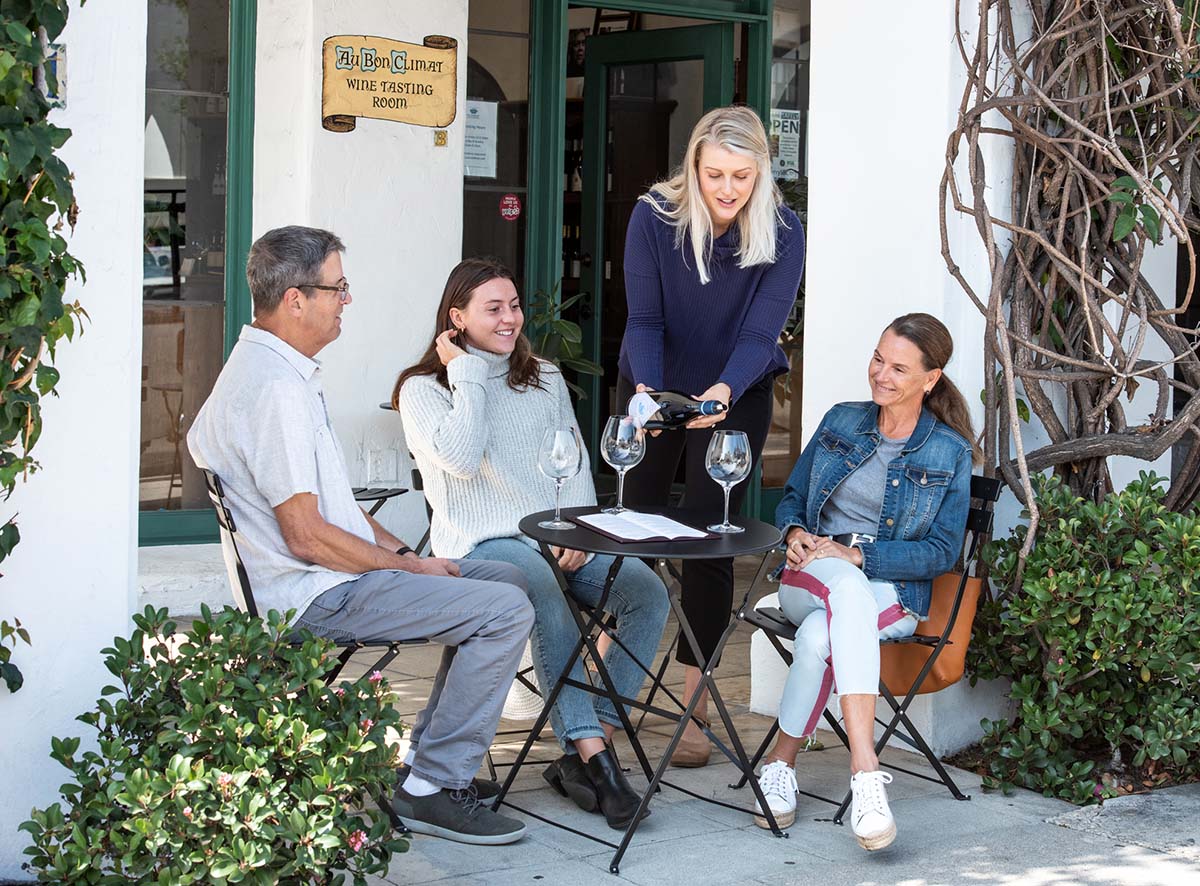
The district wraps the small towns at the heart of the valley, Los Olivos, Ballard, Santa Ynez and the northern edge of Solvang, so it is the easiest part of Santa Barbara wine country to base a day in. The town of Los Olivos itself, a single-stoplight crossroads with close to thirty tasting rooms in a few walkable blocks, sits right on the terrace and makes the obvious home base. Park once, walk Grand Avenue and the side streets door to door, and break for lunch at one of the bistros in town. To see the vineyards rather than the storefronts, drive the back roads through Santa Ynez and out toward Ballard, where the flat rows run to the foothills under the oaks.
Many estate tasting rooms here ask for a reservation, especially on weekends, while the in-town spaces are more walk-in friendly. As for timing, late spring through early fall brings the warmest, clearest weather and the busiest rooms, and harvest in September and October puts the whole valley in motion. The quiet, green secret is spring just after the winter rains, when the hills turn emerald and the crowds have not yet arrived. The district sits about a forty-five minute drive north of the city of Santa Barbara over San Marcos Pass, and a few minutes from the Highway 101 gateway at Buellton.
Food and the wines
The district’s range is a gift at the table, because it hands you a wine for almost any plate the valley sets out. The local food culture leans on Santa Maria-style oak-grilled tri-tip, ranch beef, and the lamb and citrus that grow in the surrounding hills, and the district’s own grapes were built to meet it. A warm-terrace Cabernet Sauvignon or Bordeaux blend, with its firm tannin, is made for that charred, fatty tri-tip, the tannin binding to the protein and softening as the fat coats the tongue, a textbook complementary match. A peppery district Syrah does the same trick from the Rhone side, its dark fruit and savory edge lifting grilled lamb. And the crisp, herbaceous Sauvignon Blanc that put this ground on the map is a classic with fresh goat cheese, the two clicking because both carry the same green, grassy aromatics and read as a single flavor. Want a match for whatever you are cooking tonight, use our wine pairing generator to find the bottle that fits.
The Los Olivos District is the flexible middle of the Santa Ynez Valley, itself the warm heart of Santa Barbara County wine and part of the larger California wine story. Compare it with the cool, fog-fed Sta. Rita Hills to the west or the Syrah heartland of Ballard Canyon just south, or follow the grapes themselves through our guides to Cabernet Sauvignon and Chardonnay. However you wander in, the flat terrace, the oaks and the families pouring their life’s work are waiting.
From a warm-terrace Cabernet to a peppery Rhone Syrah to a bright Sauvignon Blanc, find the bottle that fits your table tonight, then come taste it where it grows.
Los Olivos District questions, answered
Where is the Los Olivos District AVA?
The Los Olivos District is a sub-appellation in the center of the Santa Ynez Valley, in Santa Barbara County on California’s Central Coast. It covers the broad alluvial terrace along the Santa Ynez River and wraps the towns of Los Olivos, Ballard, Santa Ynez and the northern edge of Solvang, about a forty-five minute drive north of the city of Santa Barbara.
When did the Los Olivos District become an AVA?
The Alcohol and Tobacco Tax and Trade Bureau established it as a federal American Viticultural Area on January 21, 2016, with the designation taking effect on February 22, 2016. It was the 232nd AVA in the United States and one of the sub-appellations nested inside the older Santa Ynez Valley AVA.
What is the Los Olivos District AVA known for?
It is known for being the flat, uniform alluvial terrace in the middle of the Santa Ynez Valley and for its stylistic flexibility. Its warm days and cold nights let it ripen Bordeaux reds, Rhone reds and bright whites all on the same even ground, a range few single appellations can match.
What grapes grow in the Los Olivos District?
Bordeaux varieties such as Cabernet Sauvignon, Cabernet Franc, Merlot and Sauvignon Blanc grow well here, alongside Rhone grapes like Syrah, Grenache, Viognier and Roussanne, plus Chardonnay and some Italian and Iberian varieties. The district is defined by range rather than a single signature grape.
What makes the Los Olivos District soil and climate special?
It sits on the only broad alluvial terrace plain of the Santa Ynez River, a nearly flat sheet of well-drained gravelly sandy loam and clay loam. The inland location gives it only a thin marine fog layer that burns off fast, producing warm sunny days and cold nights, a cool Winkler Region III that ripens late grapes while keeping their acidity fresh.
How does the Los Olivos District compare to the Sta. Rita Hills?
The Sta. Rita Hills sits at the cool, foggy western mouth of the valley and is a Pinot Noir and Chardonnay region. The Los Olivos District lies further inland on the warm valley floor, with much less fog and warmer days, which is why it ripens Bordeaux and Rhone grapes rather than focusing on cool-climate Pinot.
Who created the Los Olivos District AVA?
The appellation was established after a petition authored by Fred Brander of Brander Vineyard, who studied the area’s soils and climate beginning around 2005 and submitted the formal petition on behalf of local vintners and growers. His research showed the flat river terrace was distinct enough to stand as its own AVA.
What food pairs with Los Olivos District wine?
The local table leans on Santa Maria-style oak-grilled tri-tip, ranch beef and lamb, which a firm Cabernet Sauvignon or Bordeaux blend meets perfectly as its tannin binds to the fat. A peppery district Syrah loves grilled lamb, and the district’s herbaceous Sauvignon Blanc is a classic with goat cheese, since both share the same green, grassy aromas.