
Drive south out of San Luis Obispo on Edna Road and the valley opens like a held breath. To the east stand the Nine Sisters, a chain of ancient volcanic cones marching toward Morro Bay. To the west, a low gap in the hills lets the Pacific pour its cold breath straight across the vines. This is Edna Valley, one of the coolest and longest growing seasons in California, and right at its heart sits Tolosa, a winery built by people who first knew this ground as farmers.
The growers who became vintners
Tolosa takes its name from Mission San Luis Obispo de Tolosa, the Franciscan mission founded in 1772, where some of the first serious wines in California were pressed. The modern story begins in the late 1980s, when vintner Robin Baggett bought a historic cattle ranch along Edna Road and started running cattle on it. The cold ocean wind and the limestone underfoot kept telling him the same thing, that this was frontier country for cool-climate Pinot Noir and Chardonnay. In 1988 he and his partner Bob Schiebelhut began planting vineyards on what became Edna Ranch.
By 1998, with Jim Efird alongside them, the growers turned vintners and founded Tolosa. They had spent a decade learning the land as a vineyard before they ever called themselves a winery, and that grower-first instinct still runs through everything here. In 2017 the winery brought in Frederic Delivert, a winemaker whose path from Toulouse in southern France to this valley feels almost written in advance given the Tolosa name. He has spent his years here reading Edna Ranch block by block, chasing depth and balance rather than raw power.
The people who built Tolosa knew this ground as a working ranch for a decade before they ever called it a winery.
Answer a few quick questions and get your wine personality, your best matches, and where to taste them.
Start the quizWhy Edna Valley grows great Burgundy grapes
Edna Valley is small, cool, and unusually open to the sea. A break in the coastal hills near Los Osos lets marine air and fog funnel straight inland off the Pacific, which sits only a handful of miles away. Mornings start grey and damp, the sun burns through by midday, and by late afternoon the cool wind returns. That rhythm stretches the growing season longer than almost anywhere in California, so the grapes hang for months and ripen slowly while holding onto their natural acidity.
Underneath the vines lie ancient marine sediments, sandy and silty loams over limestone and diatomaceous shale, the seabed of an older ocean lifted into daylight. Calcareous soils like these belong to the same broad family that gives Burgundy and Champagne their tension, and they are a large part of why Chardonnay and Pinot Noir feel so at home on Edna Ranch. The Nine Sisters volcanic peaks that line the valley are a reminder that this is restless, layered ground, not a flat valley floor.
The wines: transparency over power
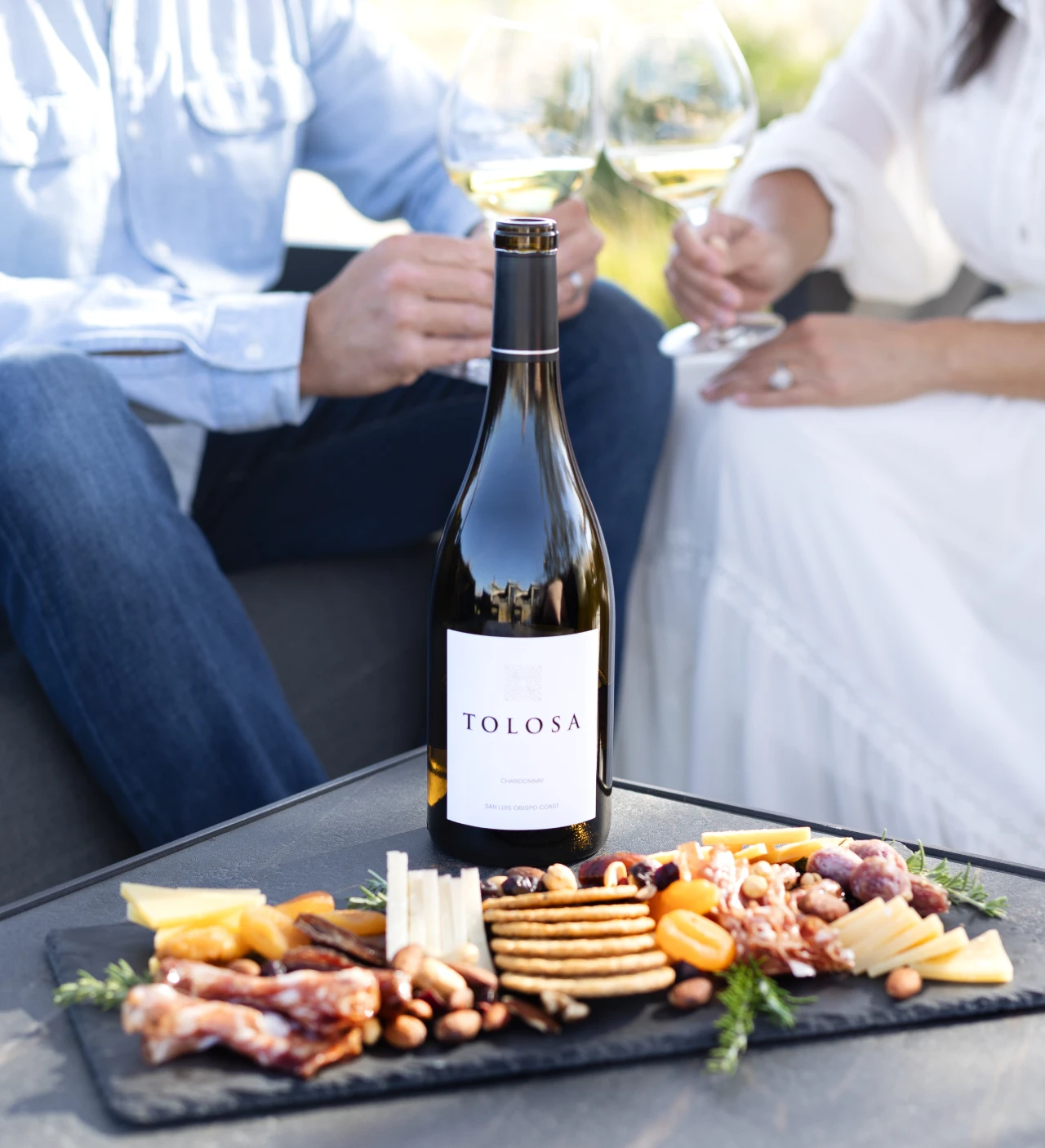
Tolosa is, at its core, a Chardonnay and Pinot Noir house. The Chardonnays run from bright and mineral to richer barrel-shaped bottlings, but they keep the cut and lift that cool Edna fruit gives them. The Pinot Noirs are perfumed and red-fruited, with the savory edge and fine structure that long hang time on calcareous soils tends to bring. The 1772 label, named for the mission founding year, gathers some of the most expressive lots on the estate.
These are wines made to go to the table, not to shout from the glass. There is a transparency to them, a sense that the winemaking is trying to step aside and let Edna Ranch speak. For a visitor, that makes a side-by-side tasting here a quick education in what cool-climate California can do with the two great Burgundian grapes.
Tell us what is on the table and our pairing generator finds the wine that makes the meal.
Find your pairingWhat to pour it with
Cool-climate Pinot Noir is one of the most flexible reds at any table, and Tolosa Pinot is a textbook case. Its bright acidity and silky, low-to-moderate tannins make it sing with seared duck breast, especially with a cherry or plum pan sauce, because the fruit in the wine echoes the fruit on the plate while the acid cuts the richness of the duck fat. Roast chicken with mushrooms is the everyday version of the same idea, the earthy mushrooms meeting the savory side of the Pinot on shared umami notes.
The Chardonnay wants richness to play against. A barrel-aged bottling next to butter-poached fish or a creamy risotto is a congruent pairing, richness matched to richness, while the wine acidity keeps the dish from feeling heavy. The leaner, mineral Chardonnays do the opposite job, slicing through fried calamari or a plate of oysters the way a squeeze of lemon would. Keep firm tannin away from delicate white fish, and reach instead for the Chardonnay, which has the acid to lift it.
Find your Edna Valley match
Take the 60-second quiz and we will point you to the cool-climate wines and tasting rooms you will love.
Find your wineTolosa Winery: common questions
What is Tolosa Winery known for?
Who founded Tolosa and who makes the wine?
Where is the Tolosa tasting room and when is it open?
How did Tolosa get its name?
What should I taste first at Tolosa?
What food pairs with Tolosa wines?
More wineries in the SLO Coast
See all the SLO Coast wineries
Are you affiliated with this winery?