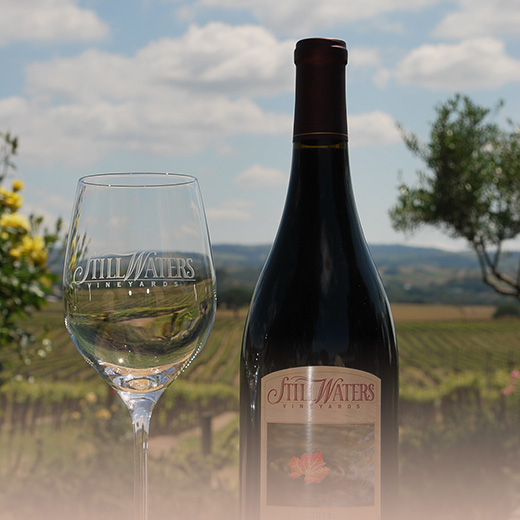
There is an acre of olive trees at Still Waters that was already a century old when Paul and Patricia Hoover bought the place. Those gnarled, 135-year-old trees, still producing oil today, set the tone for the whole estate: patient, rooted, in no hurry. The Hoovers planted their vineyard in the El Pomar hills in 2003 and named it for the calm they found there, and more than twenty years on, Still Waters remains exactly what its name promises.
A patient family and an ancient orchard
Paul and Patricia Hoover met as Cal Poly students in the late 1970s and built careers before they built a winery. Paul ran hotels and an insurance company, but through the 1990s his passion turned steadily toward winemaking, and in 2003 the couple founded Still Waters Vineyards in the El Pomar District. More than twenty years later, they are still at it, a family operation that has stayed true to its roots while the region exploded around it.
The estate came with a remarkable inheritance: an acre of olive trees, roughly 135 years old, that the Hoovers still farm for oil, blending fruit from sevillano, frantoio, ascolano, and mission trees. Those ancient olives give Still Waters a sense of deep time you cannot plant or fake, and they sit at the heart of an estate that produces both wine and olive oil, a true farm in the old Mediterranean tradition.
Still Waters farms an acre of 135-year-old olive trees, older than California’s modern wine industry, and presses their fruit into estate oil alongside its wine.
Answer a few quick questions and get your wine personality, your best matches, and where to taste them.
Start the quizWine and olives, old companions
Still Waters sits in the El Pomar District, the gently rolling, terraced center of Paso Robles, where deep loams and clay loams cover hills between roughly 740 and 1,600 feet. The district carries a Region II climate, warm in the day but reliably cooled by marine air drifting in on summer evenings, the temperature swing that gives Paso reds their balance of ripeness and freshness.
That same moderate, sunny climate is why the ancient olive orchard has thrived here for well over a century. Olives and wine grapes are old Mediterranean companions, both happiest on warm, well-drained hillsides with cool nights, and El Pomar offers exactly that. The Hoovers farm both, which gives the estate its character: a working ranch where the wine and the oil come from the same patient ground.
The wines and the oil
Still Waters makes a range of estate wines in a warm, approachable Paso Robles style, with Bordeaux and Rhone reds at the core, the grapes best suited to the El Pomar sun. After two decades of farming the same ground, the Hoovers know their blocks intimately, and the wines reflect that, ripe and generous but balanced by the district’s cool nights.
The estate is just as proud of its olive oil, pressed from those 135-year-old trees and blended from four classic varieties. Few wineries can pour you a glass of estate red and a taste of estate oil from trees older than the state’s wine industry. That combination, wine and oil from one historic property, is the soul of Still Waters and a big part of what makes a visit here feel like stepping onto a real Mediterranean farm.
Tell us what is on the table and our pairing generator finds the wine that makes the meal.
Find your pairingWhat to pour it with
Start with the estate olive oil, because it tells you how to eat here. Drizzle that peppery, green oil over warm bread, ripe tomatoes, or grilled vegetables, and pour an estate red alongside. The Bordeaux reds, with their firm tannins, want grilled or roasted red meat: a ribeye, a leg of lamb, a beef stew, where the protein and fat soften the tannins and the wine cuts the richness.
The Rhone reds, darker and more peppery, love smoke and herbs, lamb chops off the grill, sausages, a rosemary-roasted chicken. Lean on the Mediterranean table the estate evokes: olives, hard cheese, grilled meats, tomato, and good oil. Salt and fat soften tannin and lift fruit, so a well-seasoned, oil-rich dish makes these estate reds taste rounder and more generous. It is farm food and farm wine, and they were made for each other.
Find your kind of red
Take the 60-second quiz and we will point you to the wines and tasting rooms you will love.
Find your wineStill Waters Vineyards: common questions
What is Still Waters Vineyards known for?
Who founded Still Waters Vineyards?
Where is Still Waters Vineyards?
Does Still Waters make olive oil?
What wine does Still Waters make?
What food pairs with Still Waters wines?
More wineries in Paso Robles
- Stilson Cellars
- Stolo Vineyards
- SummerWood Winery
- Thacher Winery
- The Blending Lab Winery
- The Fableist Wine Co.
Are you affiliated with this winery?