Janis Pelletiere left Chicago on her twenty-first birthday with an entrepreneurial streak, built a Bay Area business, and three decades later sold it to move to Paso Robles. In 2014, the same season the Willow Creek District was being recognized as its own AVA, she bought a 16-acre vineyard rich in limestone. In a sub-region famous for Rhone wines, she chose to honor her Chicago Italian roots instead, planting and bottling Sangiovese, Nebbiolo, Montepulciano, and Lagrein, all estate grown. The result is one of Paso’s most distinctive Italian programs.
A Chicago businesswoman plants Italy in Paso
Janis Pelletiere did not arrive in wine by way of agriculture. She left Chicago at twenty-one with the same drive that would later carry her through a successful business career in the San Francisco Bay Area. When she sold that company and looked for a next chapter closer to her two children attending school in San Luis Obispo, she landed in Paso Robles and bought a vineyard just before the 2014 harvest. The timing was almost poetic. That was the year the Willow Creek District was formally recognized as one of Paso’s eleven sub-AVAs, so Pelletiere effectively became an estate owner at the moment her corner of the region got its own name on the map.
What she did next set the property apart. The west side of Paso is Rhone country, defined by Syrah and Grenache. Pelletiere looked at her limestone hillside and her own heritage and chose Italy instead. The estate, now family run with her daughter Morgan, is built around the grapes of central and northern Italy. Even the wines carry the story: a bottling named Tievoli recalls a dish her grandmother served at a Chicago-area restaurant, a small act of memory turned into a label.
In a sub-region famous for Rhone wines, she chose to honor her Chicago Italian roots instead.
Answer a few quick questions and get your wine personality, your best matches, and where to taste them.
Start the quizLimestone and the cool heart of Willow Creek
The Willow Creek District is the limestone heart of the Paso Robles west side, a band of cool, high slopes that climb from roughly 960 to nearly 1,900 feet. Its bedrock is calcareous Monterey-Formation loam and clay, the kind of chalky, mineral-rich soil that stresses vines in a productive way, forcing them to dig deep and concentrate their fruit. Classified as a Region II climate, it is one of the cooler corners of Paso, which gives grapes a longer, gentler ripening window than the valley floor.
Pelletiere Estate sits squarely in that environment. The 16-acre property, with roughly 11 acres under vine on original blocks planted in the 1990s, faces south to catch sun while staying open to the marine air that pours through the Templeton Gap each afternoon. That cooling produces Paso’s signature diurnal swing, the dramatic day-to-night temperature drop that builds sugar and color during the day and preserves bright natural acidity at night. For Italian varieties, this matters enormously. Sangiovese and Nebbiolo are defined by their acidity and structure, and a site that holds onto freshness while still ripening fully is exactly what they need to taste like themselves rather than like generic California reds.
Italian varieties, estate grown
Everything in the bottle is grown on the property. Pelletiere farms its hillside sustainably and bottles only estate fruit, which means the wines are a direct read on this one limestone site. The Italian core runs deep: Sangiovese, the backbone of Chianti, brings tart cherry, dried herb, and a savory, food-friendly grip; Nebbiolo, the grape of Barolo, offers rose, tar, and red cherry over famously firm tannin and high acid; Montepulciano gives darker plum and a plush, approachable texture; and Lagrein, an alpine variety from Italy’s far north, contributes inky color, blackberry, and a cool, almost peppery edge. The estate also grows Aglianico and Primitivo alongside small plantings of Syrah and Viognier.
The winemaking philosophy is deliberately restrained. The aim is balance and clarity, picking at optimum ripeness and letting the limestone soil and cool climate speak rather than burying the fruit under oak or alcohol. These are wines made to sit at a table, built around acidity and structure the way Italian wines traditionally are, which is to say built to be drunk with dinner rather than admired on their own.
Tell us what is on the table and our pairing generator finds the wine that makes the meal.
Find your pairingWhat to pour Pelletiere with
Italian grapes were bred over centuries to partner with Italian food, and the chemistry explains why. Sangiovese and Nebbiolo are high in both acid and tannin, and that combination is purpose-built for rich, savory, tomato-based cooking. The acid in the wine mirrors the acid in a tomato sauce so neither tastes sour, while the tannin binds to the fat and protein in cured meats, braised beef, and aged cheese, scrubbing the palate clean between bites. Pour the Sangiovese with a classic Bolognese, a margherita pizza, or a board of salami and Parmigiano.
Nebbiolo wants something richer to tame its grip: braised short ribs, mushroom risotto, or a slow-cooked osso buco. Montepulciano, softer and fruitier, is the easy weeknight choice for pizza and grilled sausage. Lagrein, with its dark fruit and structure, takes beautifully to Paso’s own red-oak-grilled tri-tip, where the wine’s tannin cuts the charred fat. To match a specific Pelletiere bottle to what you are cooking, our wine pairing generator can help.
Visiting Pelletiere Estate
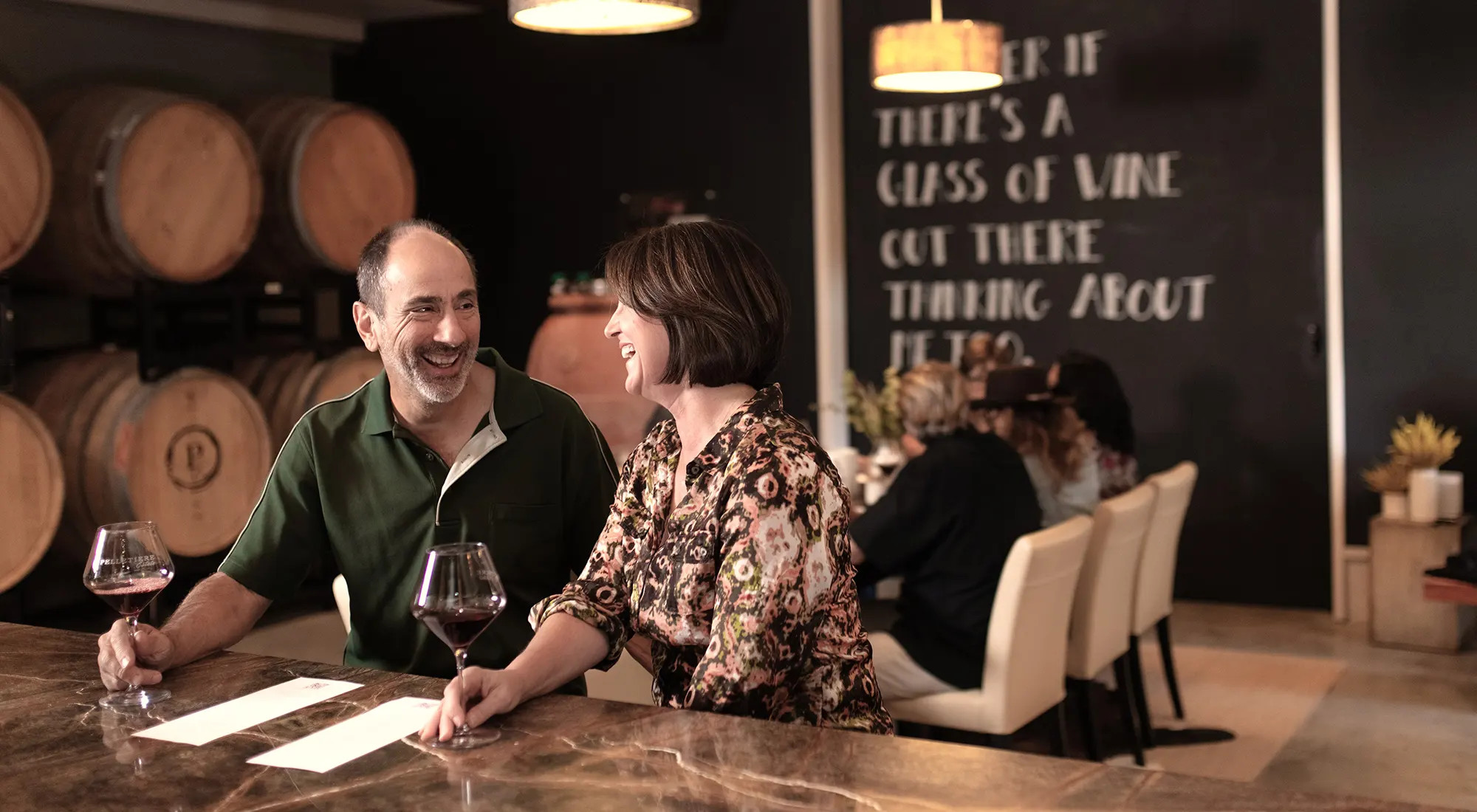
Pelletiere Estate pours on its working vineyard at 3280 Township Road, deep in the Willow Creek District, where the experience is intimate and rooted in place rather than polished and corporate. Tastings happen on the property itself, surrounded by the limestone hillside that grows the wine, and a restored 1890s farmhouse on site speaks to the estate’s sense of history. Because Italian varieties are still a rarity on the Paso west side, a visit here is a genuinely different tasting from the Rhone-heavy norm, and a good reason to slow down. To plan the rest of your west-side route, our Paso Robles guide covers the districts, the drive, and how to build a day around Willow Creek.
Let us match you to the right Paso bottle
Take the 60-second quiz and we will point you to the Paso wines and tasting rooms you will love.
Find your winePelletiere Estate Vineyard and Winery: common questions
Who is behind Pelletiere Estate?
What grapes does Pelletiere Estate grow?
Where is Pelletiere Estate located?
Why grow Italian varieties in Paso Robles?
What food pairs best with Pelletiere wines?
Is Pelletiere Estate really all estate grown?
What is the Tievoli wine?
Can I visit the vineyard?
More wineries in Paso Robles
- Penman Springs Vineyard
- PIUS Estates
- Rava Wines + Events
- Red Door Ranch Vineyards
- Riboli Family Wines
- RN Estate Vineyard & Winery
Are you affiliated with this winery?