Damian Grindley met his future wife Amanda underground, deep in a cave in Australia, headlamps cutting the dark. He grew up on the Isle of Anglesey in North Wales, took a horticulture degree at Reading and an oenology certificate at Adelaide, then made wine in Australia and Europe and for Kendall-Jackson and Gallo before he wanted his own ground. In 2012 the couple bought a westside Paso Robles vineyard whose limestone soils mirror the caves of the Brecon Beacons back home. The name stuck. Twenty-four months later the first wines were in bottle.
The cavers who came up for air
Caving is not a metaphor here. Amanda worked as a cave and site interpreter at a World Heritage park in Australia, and the couple’s shared passion for limestone, for the slow chemistry of water and stone, runs straight through the brand. When they found the property on Vineyard Drive, the calcareous clay underfoot felt like the Welsh cave country that gives Brecon its name.
Damian has spent decades arguing that Paso Robles should not borrow anyone else’s playbook. He has said he wants the region to do its own thing rather than be beholden to some old-world definition of style, and he treats oak as a framework to complement the fruit rather than dominate it, chasing wines of strength with soft tannins. Amanda led the design of the contemporary tasting room and runs the hospitality with an easy Australian warmth.
The estate holds the oldest surviving Cabernet Sauvignon planting in Paso Robles, vines that went in the ground in 1971.
Answer a few quick questions and get your wine personality, your best matches, and where to taste them.
Start the quizFifty-year-old roots in calcareous clay
The vineyard was first planted in 1971, one of the original sites that helped define what is now the Adelaida District on Paso’s west side. Those original Cabernet Sauvignon and Cabernet Franc vines, now past the half-century mark, were recognized by the Historic Vineyard Society. Brecon has propagated budwood from them to extend the bloodline into newer blocks.
This is classic Adelaida terroir, high rolling hills of shallow calcareous bedrock, where the Templeton Gap funnels cool Pacific air inland each afternoon. Warm days build ripeness and color, then night temperatures fall hard, locking in acidity and aromatics. Old vines on limestone, with that big diurnal swing, give fruit with concentration and lift in equal measure.
From Albarino to old-vine Cabernet Franc
The white that turns heads is Albarino, a Galician grape rarely seen in California and one Grindley champions, all bright citrus and saline cut. On the red side the old-vine Cabernet Franc is a signature, perfumed and savory, with the kind of fine tannin only mature vines deliver. Cabernet Sauvignon, Malbec and Petit Verdot round out the Bordeaux side, often woven into a Meritage blend.
The Rhone wines carry the house humor. Forty Two is a Grenache, Syrah and Mourvedre blend, and the Syrah and Viognier co-ferment goes out under the cheeky name Haggis Basher. Critics have taken notice, with high competition scores across the Malbec, Cabernet Franc and Mourvedre. Taste through and you feel the through-line, ripe fruit reined in by structure, oak kept on a short leash.
Tell us what is on the table and our pairing generator finds the wine that makes the meal.
Find your pairingWhat to pour Brecon Estate with
Brecon’s old-vine Cabernet Sauvignon and Cabernet Franc are built for protein and char. Tannin binds to the protein and fat in red meat, so a tannic red tastes softer and rounder the moment it meets red-oak-grilled tri-tip, the local Paso Robles ritual. Lamb, a peppercorn-crusted ribeye or anything off a live fire will do the same job, the smoke echoing the savory edge in the Cabernet Franc.
The whites pull the other way. Albarino’s high acidity cuts through richness and loves anything from the sea, oysters, grilled fish, garlicky shrimp, while its salinity flatters briny flavors. For the Rhone reds, reach for herb-roasted pork or mushroom dishes where Grenache’s red fruit and Mourvedre’s earthiness can play. If you want to match a specific dish, run it through our wine pairing generator.
Visiting Brecon Estate
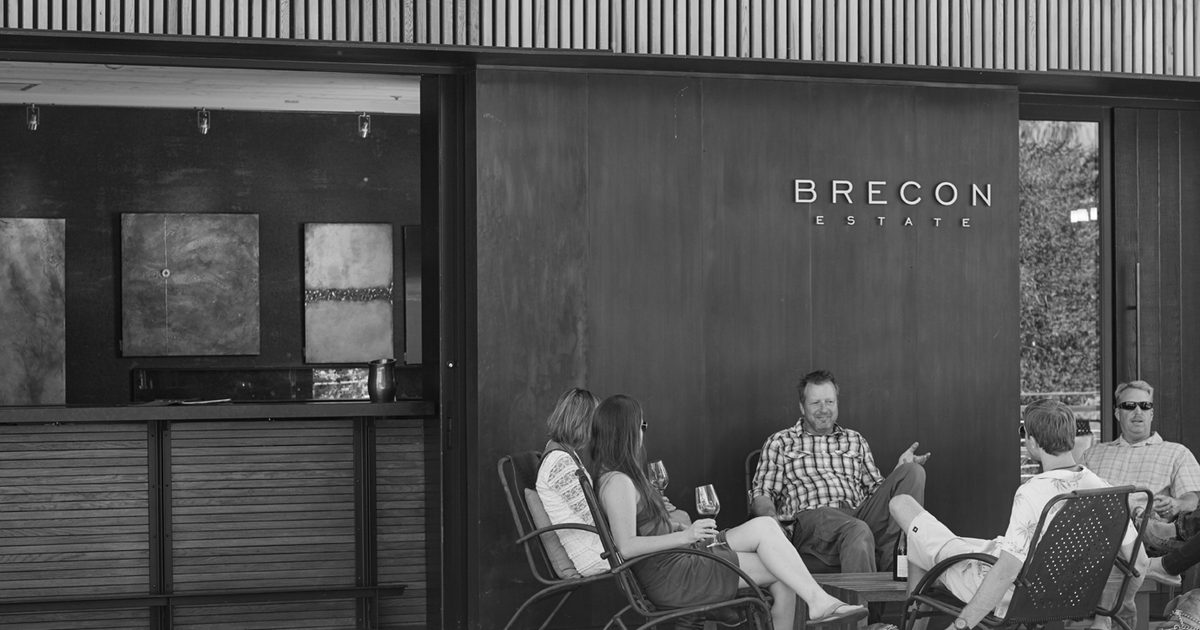
The tasting room sits beneath enormous old oaks in the Adelaida hills, a piece of contemporary architecture designed to hold a visual conversation with the vineyard slopes around it. The bar opens onto a broad concrete patio set with oversized chairs and umbrellas, and a lawn with picnic tables beyond, where you are welcome to bring your own food. It is relaxed and unpretentious, exactly the kind of place to spend an unhurried afternoon on the west side. Tastings are best booked by reservation, so confirm current hours and the experience before you go. To plan a full day on the limestone, see our Paso Robles guide.
Let us match you to the right Paso bottle
Take the 60-second quiz and we will point you to the Paso wines and tasting rooms you will love.
Find your wineBrecon Estate: common questions
Who owns Brecon Estate?
Why is it called Brecon Estate?
How old are the vines at Brecon Estate?
What wines is Brecon Estate known for?
What food pairs well with Brecon Estate wines?
Where is Brecon Estate located?
Do I need a reservation to visit Brecon Estate?
What is the Adelaida District known for?
More wineries in Paso Robles
- Brochelle Vineyards
- Bushong Vintage Company
- Cab House at Hansen Vineyards
- Caelesta Wines, Vineyard, and Truffiere
- Cairjn Wine Cellars
- Calcareous Vineyard
Are you affiliated with this winery?